 CEREBROSPINALECTOMY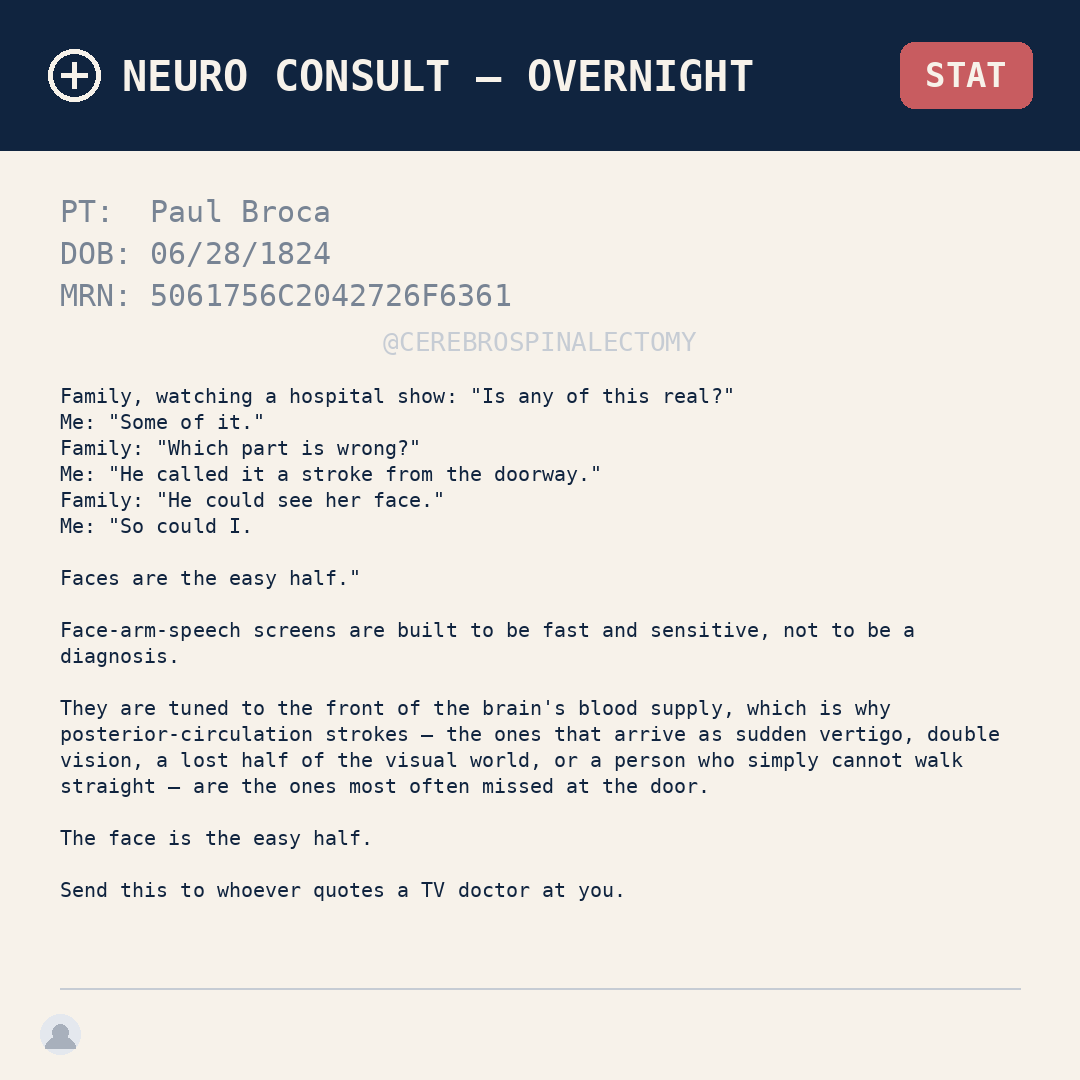
Family, watching a hospital show: "Is any of this real?"
Me: "Some of it."
Family: "Which part is wrong?"
Me: "He called it a stroke from the doorway."
Family: "He could see her face."
Me: "So could I. Faces are the easy half."
Face-arm-speech screens are built to be fast and sensitive, not to be a diagnosis. They are tuned to the front of the brain's blood supply, which is why posterior-circulation strokes — the ones that arrive as sudden vertigo, double vision, a lost half of the visual world, or a person who simply cannot walk straight — are the ones most often missed at the door. The face is the easy half. Send this to whoever quotes a TV doctor at you.
Send this to whoever quotes a TV doctor at you.
EXPLAINED (ACCURACY-CHECKED)
Prehospital stroke screens such as FAST and the Cincinnati Prehospital Stroke Scale are designed as sensitive triage tools rather than diagnostic tests, and they systematically under-detect posterior-circulation stroke, which more often presents with vertigo, diplopia, visual field loss, or gait ataxia than with facial droop.
Well established in stroke systems literature — FAST/CPSS were validated as sensitive prehospital screens for anterior-circulation stroke and have documented lower sensitivity for posterior-circulation events. Non-controversial.
LIVE ONINSTAGRAM ↗
PERMANENT LINK
https://cerebrospinalectomy.com/jokes/family-watching-a-hospital-show-is-any-of-this-real/
https://cerebrospinalectomy.com/jokes/family-watching-a-hospital-show-is-any-of-this-real/
Reprint anywhere, non-commercially, with attribution to cerebrospinalectomy.com. We punch at specialties, the system, and ourselves — never at patients.