 CEREBROSPINALECTOMY
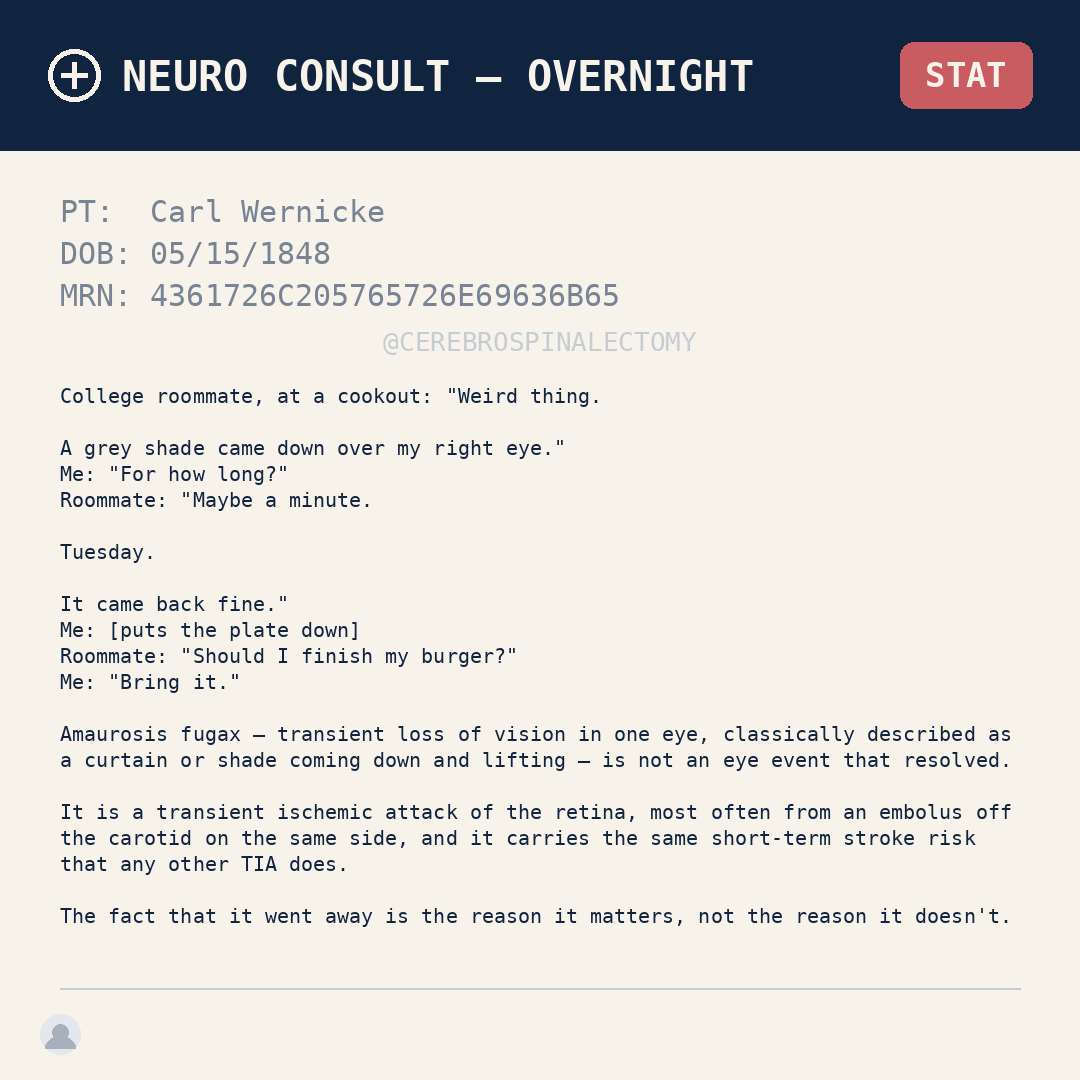
College roommate, at a cookout: "Weird thing. A grey shade came down over my right eye." Me: "For how long?" Roommate: "Maybe a minute. Tuesday. It came back fine." Me: [puts the plate down] Roommate: "Should I finish my burger?" Me: "Bring it." Amaurosis fugax — transient loss of vision in one eye, classically described as a curtain or shade coming down and lifting — is not an eye event that resolved. It is a transient ischemic attack of the retina, most often from an embolus off the carotid on the same side, and it carries the same short-term stroke risk that any other TIA does. The fact that it went away is the reason it matters, not the reason it doesn't. Send this to the friend who tells you things four days late. Send this to the friend who tells you things four days late.
EXPLAINED (ACCURACY-CHECKED)
Amaurosis fugax is transient monocular vision loss caused by retinal ischemia, most commonly embolic from ipsilateral carotid atherosclerosis; it constitutes a transient ischemic attack and carries a comparable elevated short-term risk of subsequent stroke, warranting urgent evaluation.
Established cerebrovascular medicine — amaurosis fugax as retinal TIA with carotid embolic source and elevated short-term stroke risk (AHA/ASA TIA and secondary prevention guidance). Non-controversial.
PERMANENT LINK
https://cerebrospinalectomy.com/jokes/college-roommate-at-a-cookout-weird-thing-a-grey-shade-came-down-over/
https://cerebrospinalectomy.com/jokes/college-roommate-at-a-cookout-weird-thing-a-grey-shade-came-down-over/
Reprint anywhere, non-commercially, with attribution to cerebrospinalectomy.com. We punch at specialties, the system, and ourselves — never at patients.