 CEREBROSPINALECTOMY
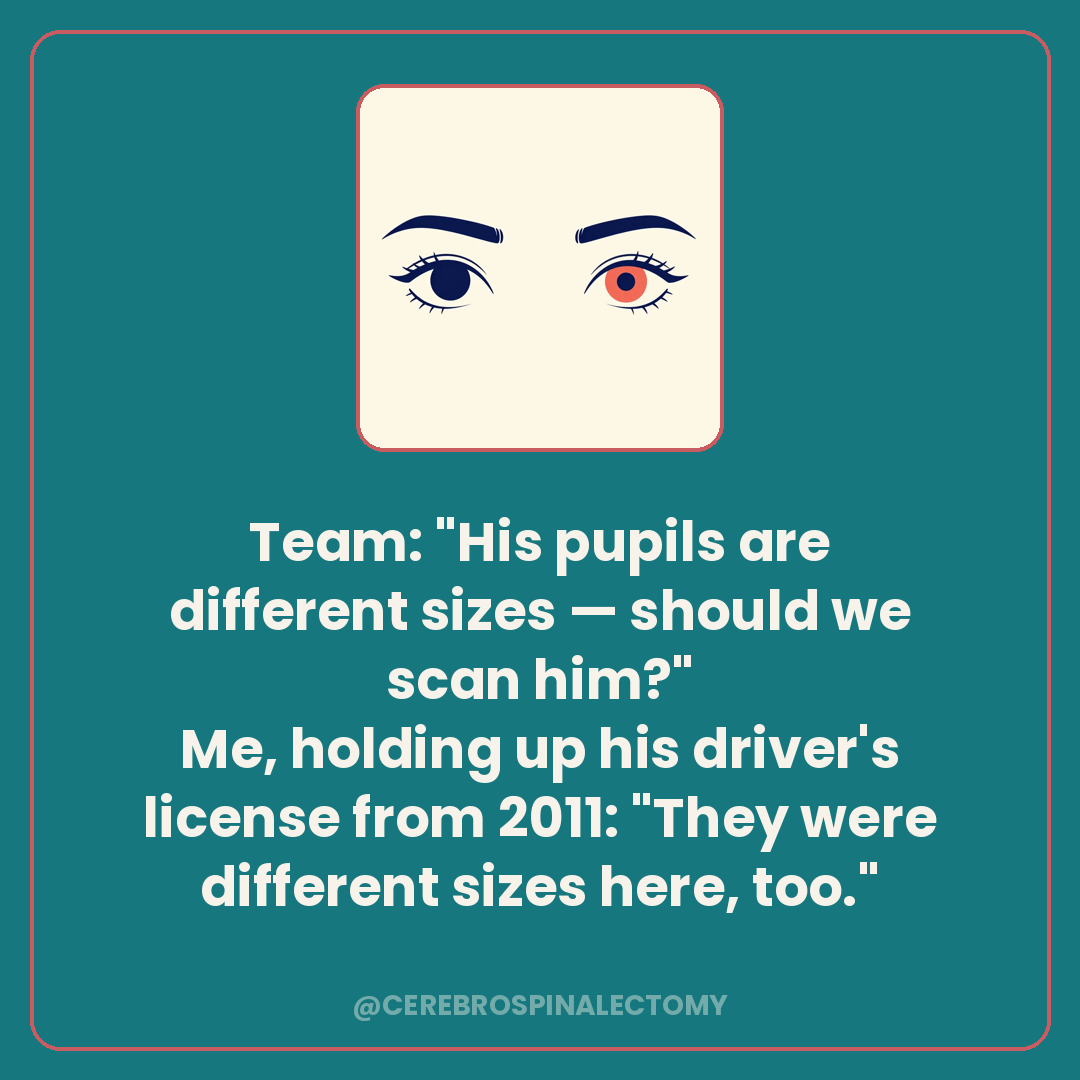
Team: "His pupils are different sizes — should we scan him?" Me, holding up his driver's license from 2011: "They were different sizes here, too." Send this to the resident who scans first and asks second.
EXPLAINED (ACCURACY-CHECKED)
Benign physiologic anisocoria is common (present in roughly one in five people) and is stable over time; comparing old photographs is a standard bedside method for establishing that a pupillary asymmetry is chronic.
Established neuro-ophthalmology: physiologic anisocoria occurs in roughly 20% of people; reviewing old photographs to establish chronicity is standard practice.
PERMANENT LINK
https://cerebrospinalectomy.com/jokes/team-his-pupils-are-different-sizes-should-we-scan-him/
https://cerebrospinalectomy.com/jokes/team-his-pupils-are-different-sizes-should-we-scan-him/
Reprint anywhere, non-commercially, with attribution to cerebrospinalectomy.com. We punch at specialties, the system, and ourselves — never at patients.